
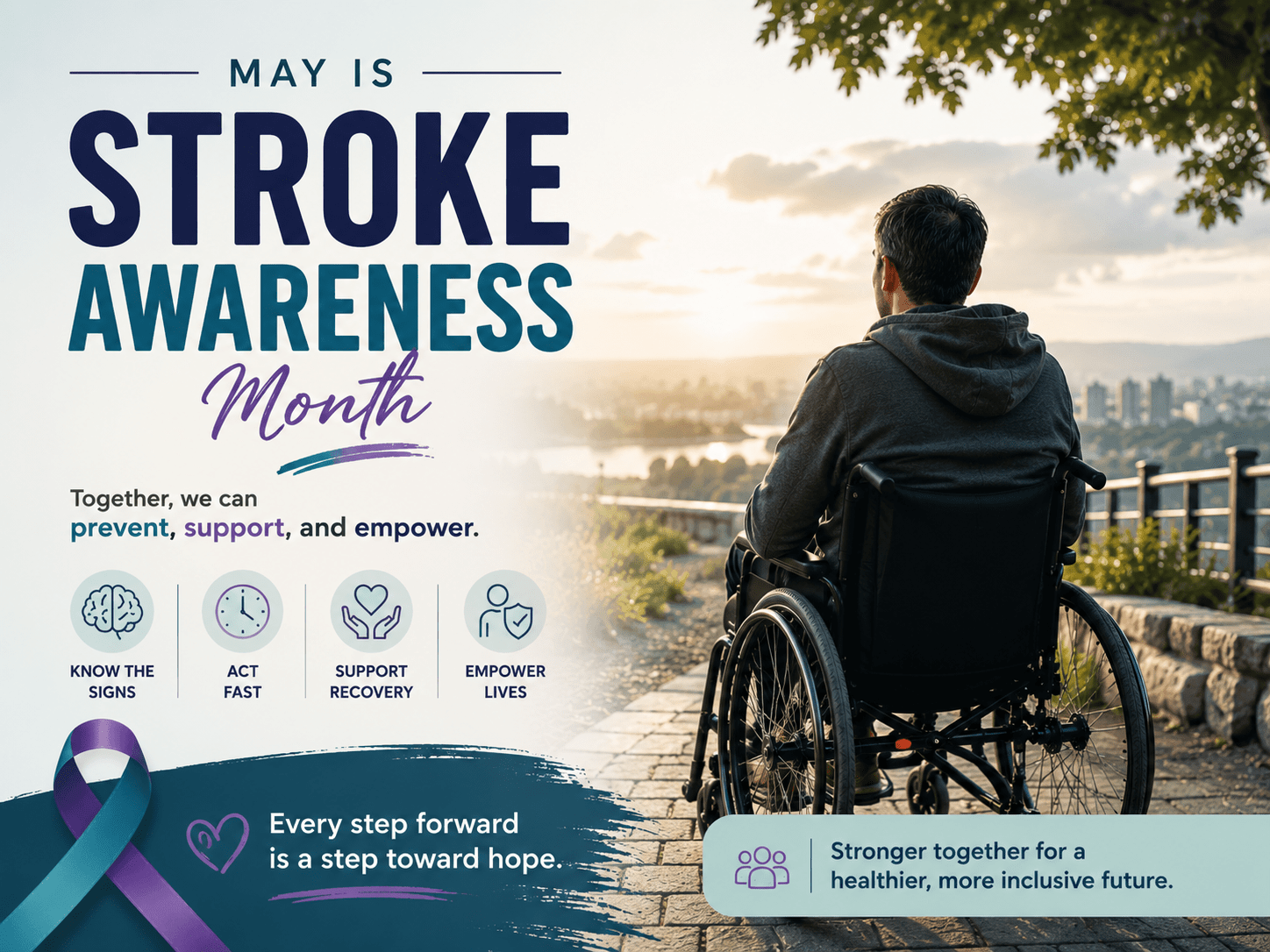
Most people who witness a stroke do not catch it in the moment. Not because they are not paying attention. Because stroke does not always look the way movies say it does. This May, we want to change that.
The Numbers Are Hard to Ignore
Here is the part that matters most: stroke is among the most treatable emergencies in medicine, but only within a narrow window of time. Doctors call it "time is brain." It is not a slogan. It is neuroscience. And it is the reason recognition matters more than almost anything else.
What a Stroke Actually Looks Like
Forget the dramatic movie version. Real strokes often look like someone who seems a little confused, or tired, or slurring slightly. They may not know anything is wrong. That is part of what makes them so dangerous. Neurologists now use BE-FAST, an updated tool that catches two earlier warning signs most people miss.
Even if symptoms pass quickly, call anyway. A TIA, or mini-stroke, is a serious warning sign of a larger event to come and should never be waited out.
Stroke, Wheelchairs, and What Recovery Really Looks Like
Stroke is the leading cause of long-term disability in the United States. That disability, for a significant number of survivors, means a wheelchair, either temporarily during recovery or as a permanent part of daily life. Yet the experience of navigating a wheelchair after stroke is rarely part of the awareness conversation.
"Nobody prepares you for who comes home from the hospital. The person is the same. Everything around them is different."
Motor dysfunction, ranging from one-sided weakness to partial paralysis, affects between 50 and 80 percent of stroke survivors in the acute phase. Balance impairment affects roughly 83 percent of survivors and is one of the leading causes of falls during recovery. For people transitioning to wheelchair use, these realities show up in very specific, practical ways every single day.
Stroke-related muscle stiffness on one side of the body makes seated positioning significantly harder. Staying upright in a chair without adequate support requires constant muscular effort that fatigues quickly and creates uneven pressure distribution.
Survivors with hemiplegia often cannot independently shift their weight. That means pressure builds in the same spots for hours. Skin breakdown becomes a real and serious risk that requires active, daily management, not passive cushioning.
For survivors with weakness or paralysis on one side, operating a manual wheelchair is genuinely difficult. Many families underestimate this challenge until they are living it. Power mobility options and proper assessments matter early.
Push for a discharge plan before leaving the hospital. Ask specifically about adaptive equipment, seating assessments, and outpatient rehab options. You are not expected to figure this out alone, but you do need to ask the right questions.
Stroke awareness is not just about knowing an acronym. It is about being the person in the room who acts when everyone else is waiting to see if it gets better. It usually does not get better on its own. What gets better is the outcome when someone moves fast.
Recovery from stroke is not a straight line. Some days feel like progress. Others feel like starting over. And through all of it, the person in the chair is still the same person they were before — still wanting to be present, still wanting to feel like themselves, still figuring out what a good day looks like now.
The body deserves support that keeps up with that. Not a cushion that gives out by noon. Not equipment that adds one more thing to manage. Just reliable, active support that quietly does its job so the person using it can focus on everything else.
👉 Learn about Ease Cushion® Gen 2
Part of the Ease May Awareness Series, covering ALS, Arthritis, Stroke, and the connection between mental health and your chair.


Dejar un comentario
Este sitio está protegido por hCaptcha y se aplican la Política de privacidad de hCaptcha y los Términos del servicio.