
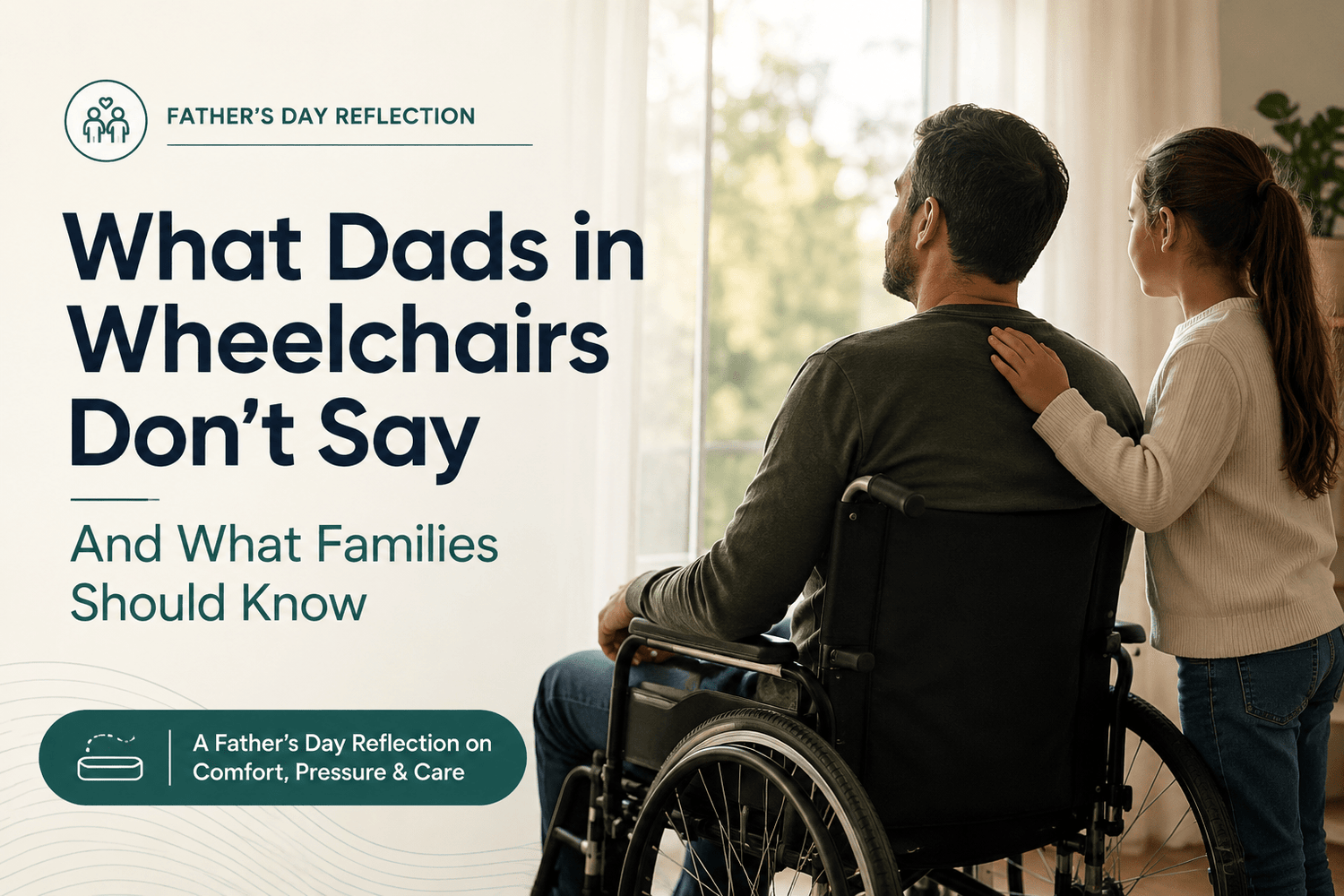
There is a particular kind of quiet that many wheelchair-using dads have mastered. When asked how they're doing, the answer is usually fine. When something is uncomfortable, it gets managed privately. When the cushion starts to feel different from how it used to feel, that change gets absorbed into the routine without much mention.
This isn't unique to dads, of course. But it is worth paying attention to — because in the context of seating and pressure, that quiet adaptation carries real consequences that families often don't learn about until something is already wrong.
This Father's Day, rather than talking about what to buy, we want to talk about what to understand.
Why discomfort goes unreported
People who use wheelchairs full-time develop a relationship with their chair that is hard to describe to someone who doesn't. It becomes an extension of the body. The adjustments become unconscious. The minor discomforts get catalogued and managed without much conscious thought.
Research into wheelchair use and pressure injury risk points to something important here: over time, the body's pain signalling in pressure-affected areas can become less reliable. Studies on ageing skin and wheelchair use note that pain sensors can become dulled in areas of chronic pressure, which reduces awareness of early-stage pressure injuries. The body stops sending clear signals. The discomfort that should be a warning becomes background noise.
For family members, this means that "I'm fine" isn't always reliable information. Not because dads are hiding something deliberately, but because the body itself may no longer be registering the problem clearly.
What the body needs that the chair can't always provide
To understand why pressure builds, it helps to understand what the body does naturally when it's free to move. Research has shown that people without mobility limitations shift their weight and adjust their position roughly 9 times per hour during sedentary tasks — mostly without realising it. These micro-movements redistribute pressure, keep circulation moving, and prevent any single point from bearing sustained load.
For wheelchair users with spinal cord injuries or limited sensation, that same research has found the rate drops to roughly 9 times per day. The body simply doesn't receive the signals that would normally prompt it to move. The natural pressure redistribution that most people take for granted is largely absent.
This is not a failure of willpower or awareness. It is a physiological reality of how sensation and mobility interact. And it is why the quality of the seating surface matters so much more for wheelchair users than for almost anyone else.
Rate at which people without mobility limitations naturally shift weight during sedentary activity — mostly unconsciously
Estimated rate for wheelchair users with spinal cord injuries — a dramatic reduction that leaves pressure largely unrelieved
Average daily seated time for full-time wheelchair users — the window during which pressure accumulates without intervention
Proportion of pressure injuries estimated to be avoidable, according to the National Pressure Injury Advisory Panel
What families can actually watch for
Because self-reporting is unreliable, families and caregivers are often better positioned to notice early signs than the person in the chair. A few things worth knowing:
Leaning to one side, shifting frequently, or spending less time sitting upright can all be signs that a cushion has lost its support - even if nothing is said.
The tailbone, hips, and thighs bear the most load in seated positions. Redness that doesn't fade within 30 minutes after repositioning warrants medical attention.
Most foam cushions lose structural integrity within 6 to 12 months. A cushion that looks fine on the outside may no longer be providing meaningful support underneath.
Unusual tiredness in the afternoon, or reluctance to leave the house for longer outings, can sometimes trace back to seating discomfort that hasn't been named.
These are not alarming signs in themselves. But they are worth noticing and, when in doubt, worth raising with an occupational therapist or seating specialist who can do a proper assessment.
The cushion conversation most families never have
Seating assessment is a standard part of wheelchair provision. But once a cushion is issued, it rarely comes up again in routine care - despite the fact that its condition changes significantly over time. Many families assume that if the cushion is still there and still being used, it must still be working. That assumption is worth revisiting.
A useful question to ask, not just on Father's Day but periodically: when was the cushion last assessed? Not just looked at, but properly evaluated for whether it's still providing the kind of support it was originally prescribed for?
If the answer is "I'm not sure," that's worth following up on. An occupational therapist can assess current seating needs and recommend whether a cushion is still appropriate - or whether something has changed in a way that warrants a different approach.
A note on active seating
For families who want to understand their options, it's worth knowing that not all wheelchair cushions are passive. A category of smart wheelchair cushions now exists that incorporates active pressure cycling - meaning the cushion itself gently redistributes load at regular intervals, rather than relying on the user to shift position manually.
This approach is particularly relevant for users with limited sensation or mobility, where the natural weight-shifting that relieves pressure simply doesn't happen at the rate the body needs. The technology is not new, studied and applied in clinical and military contexts but it remains underused in everyday wheelchair seating.
Moving Beyond the Product Matrix: Changing the Conversation
When navigating seating health with an occupational therapist or clinical specialist, the objective must evolve. The goal is no longer to find a cushion that simply feels "comfortable" for the first twenty minutes. The conversation must shift to a much more rigorous question:
"How does this seating system actively fight static pressure over the course of an entire day?"
The solution to the silent danger of pressure injuries isn't just a better piece of passive foam. It is an active intervention. For the families who love them, understanding that distinction is the most meaningful step toward protecting the dads who will never complain about the pressure themselves.
⚠️ Disclaimer: This content reflects individual customer experiences and is not intended to diagnose, treat, or cure any medical condition. Viewer discretion is advised.



コメントを書く
このサイトはhCaptchaによって保護されており、hCaptchaプライバシーポリシーおよび利用規約が適用されます。